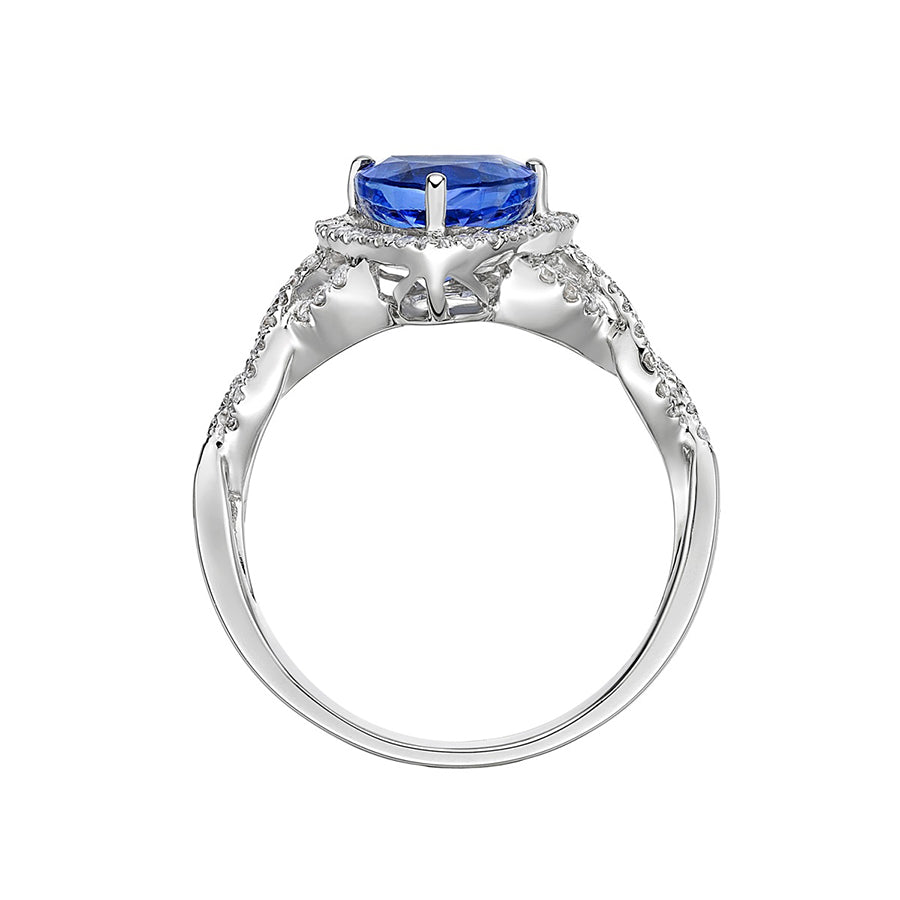
Article: 5 Ways to Spot Fake Tanzanite
5 Ways to Spot Fake Tanzanite
5 Ways to Spot Fake Tanzanite
Tanzanite has a rather useful advantage when it comes to fakes: while several materials can look remarkably like it, they don’t actually behave like tanzanite when you examine them properly.

And contrary to what you may see advertised online, there is currently no commercially established synthetic or lab-grown tanzanite. A stone sold as “synthetic tanzanite” is almost certainly a simulant — another material being used because it resembles tanzanite. Gem-A specifically identifies synthetic forsterite as a convincing tanzanite simulant.

Common Tanzanite Simulants
Some of the materials you may encounter include:
- Synthetic forsterite – probably the most convincing and important tanzanite simulant. It can produce extremely attractive blue and violet colours and can sometimes be surprisingly dark and richly saturated.
- Cubic zirconia (CZ) – inexpensive and widely available. It often looks noticeably more brilliant or “sparkly” than tanzanite.
- Synthetic sapphire – can be manufactured in blue and violet-blue shades that superficially resemble tanzanite.
- Glass – one of the cheapest imitations. Under magnification, you may see bubbles, flow lines or other indications of its glassy origin.
- Synthetic spinel – blue synthetic spinel has long been used to imitate various blue gemstones.
- Iolite – this one is actually a natural gemstone, not a synthetic. Its blue-violet colour and strong pleochroism can occasionally cause confusion with tanzanite.
- Coated stones – coatings can also be used to improve or create blue-violet colour. GIA has documented cobalt- and titanium-containing coatings applied to pale tanzanite or zoisite, although technically this is a treatment, rather than a completely different tanzanite simulant.
Of all these, synthetic forsterite is the one worth remembering because it can be a genuinely convincing tanzanite imitation.
1. Don’t Judge Tanzanite by Colour Alone
Beautiful blue-violet colour is certainly a good start.
Natural tanzanite is strongly pleochroic, which means its colour changes according to the direction from which you view the crystal.

But seeing blue and violet doesn’t prove that you have tanzanite.
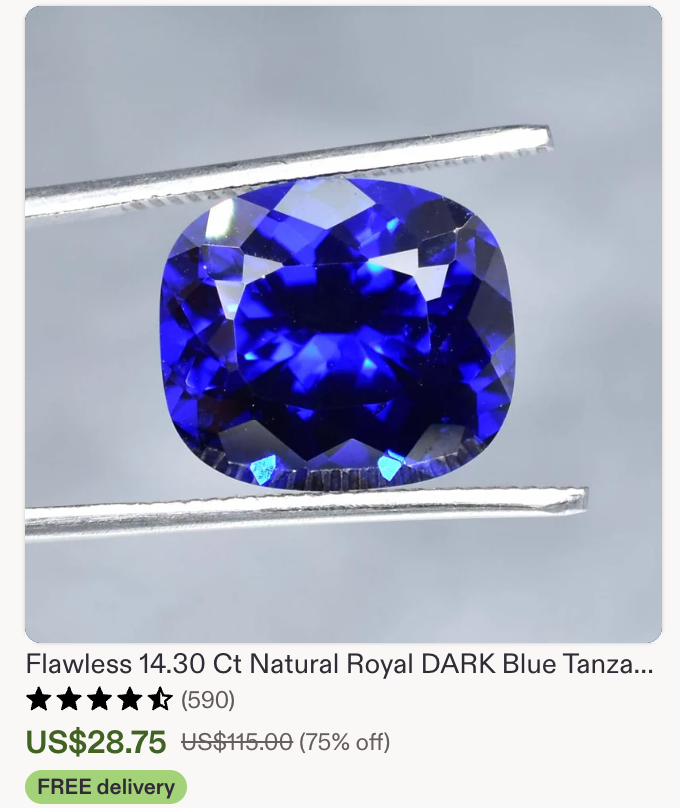
Synthetic forsterite can also display vivid blue and purple pleochroic colours, which is part of what makes it such an effective imitation. And some other natural stones can show pleochrism - plus as we can see from this listing on Esty, below there are some obviously fake tanzanites listed which show two colors too.. Perhaps the image below is synthetic alexandrite, but I cant be sure of anything other than it is NOT tanzanite.
So colour is useful — but it isn’t enough.

2. Look for Suspiciously Obvious Facet Doubling
Here is one of my favourite quick clues.
Some gemstones split light travelling through them into two rays. Gemmologists call this birefringence. Think of it as the gemstone equivalent of seeing slightly double.
Synthetic forsterite has much stronger birefringence than tanzanite.

The Visual Effect
If you look through the top of a faceted synthetic forsterite with a loupe, particularly towards the pavilion facets underneath, facet junctions can appear conspicuously doubled or fuzzy.
Instead of seeing:
- one crisp facet line
you may see:
- two slightly separated lines.
Tanzanite itself is also slightly birefringent, so saying that it has no birefringence isn’t technically correct. The important point is that you don’t normally get the same conspicuous facet doubling seen in synthetic forsterite.
If it looks a little like you are cross-eyed and everything underneath the stone has gone fuzzy or doubled, you may well be looking at synthetic forsterite.
Pro trick: turn the stone slowly under a 10× loupe and look through the crown towards the back facet junctions. Very obvious doubling should make you suspicious.
It isn’t absolute proof — but it is a very useful clue.
3. Turn the Stone and Watch the Colours
Rotate the gemstone slowly while looking at it from different directions.
Real tanzanite should demonstrate pleochroism - showing both blue and violet- rather than behaving like a stone that is simply one uniform shade of blue.
If the stone stays essentially the same artificial-looking blue regardless of direction, that warrants further investigation.
This can help eliminate some glass, CZ and other imitations.
But there is an important catch.
Synthetic forsterite can also be strongly pleochroic, and so can iolite.
 So if your mystery gemstone flashes blue in one direction and purple in another, you still haven’t proved that it is tanzanite.
That is why several tests should always be considered together.
If you suspect you have glass, cubic zirconia or another simulent, you can also buy a small, inexpensive tool called a polariscope, which can help determine whether a gemstone is singly or doubly refractive.

4. A Refractometer Settles the Argument Very Quickly
This is where gemmology becomes wonderfully less subjective.

Different gemstones have characteristic refractive-index ranges, and tanzanite and its common simulants are sufficiently different that basic gemmological testing can separate them very quickly.
Unfortunately, a refractometer isn't something most people have sitting in the kitchen drawer next to the can opener - and to buy one will be about $150.00 on ebay, pls you will need a little bottle of special liquid to coat the stone in you are testing. But almost any competent gemologist should have access to one.
5. If the Price Makes Absolutely No Sense, Investigate
This isn’t a gemmological test, but nevertheless quite a useful one.
Fine tanzanite is rare, particularly once you start looking at larger stones with excellent clarity and genuinely rich colour.
So if someone is offering you an enormous, flawless, intensely blue-violet “tanzanite” for a price that seems almost comically low, don’t assume you have discovered the deal of the century.
You may have. But I’d sense-check that exciting feeling that you’ve discovered an amazing treasure before reaching for your credit card.

What About “Lab-Grown Tanzanite”?
This is where terminology causes a lot of confusion.
Synthetic gemstones are not simply fake stones.
A true synthetic gemstone has essentially the same chemical composition and crystal structure as its natural counterpart — it was simply grown artificially in a lab rather than formed naturally underground over millions of years.
Synthetic ruby and sapphire, for example, have existed for well over a century. And lab diamonds have become so good — and so widely available — that they are having a very real impact on natural diamond prices.
Tanzanite is different.
There is currently no known commercially established method producing true synthetic tanzanite.
So:
Synthetic forsterite ≠ synthetic tanzanite.
It is an entirely different material that happens to make a very good imitation.
That distinction matters enormously when buying gemstones online.
So Can You Identify Fake Tanzanite at Home?
Sometimes you can spot enough warning signs to know that something isn’t right.
There is no little pen-style tester, like the diamond testers you may have seen, that can simply beep and tell you whether your stone is tanzanite.
You might notice:
- conspicuous facet doubling;
- colour that doesn’t look right;
- bubbles or flow lines suggesting glass;
- excessive CZ-like brilliance; or
- a price that makes absolutely no commercial sense.
But there is an important difference between suspecting that a gemstone isn’t tanzanite and positively identifying what it actually is.
For certainty, you need to have the stone tested by a competent gemologist.
A good tanzanite imitation can fool your eye. It won’t fool basic gemological testing.